Why should you choose Solidus versus Spree? The projects share a common history up until 2015. That year, Solidus forked off of Spree and began a new direction. Since then, a lot has changed, but a lot has stayed the same.
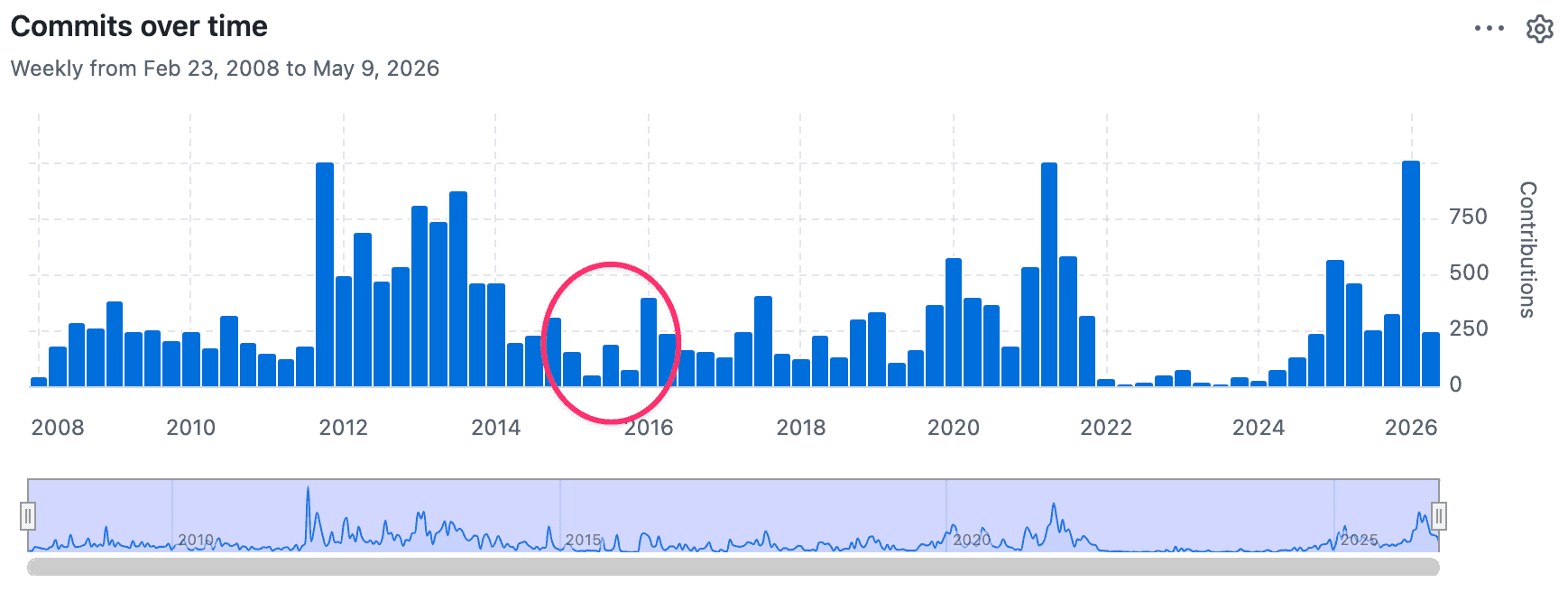
Before we dive into the differences, it’s important to understand the history. Solidus is a community-led fork of Spree that kicked off shortly before the corporate backing of Spree evaporated, leaving the project unmaintained. The project ultimately picked up new leadership, but during that gap much of the community moved to the new fork. You can see the gap in Spree’s commit frequency:
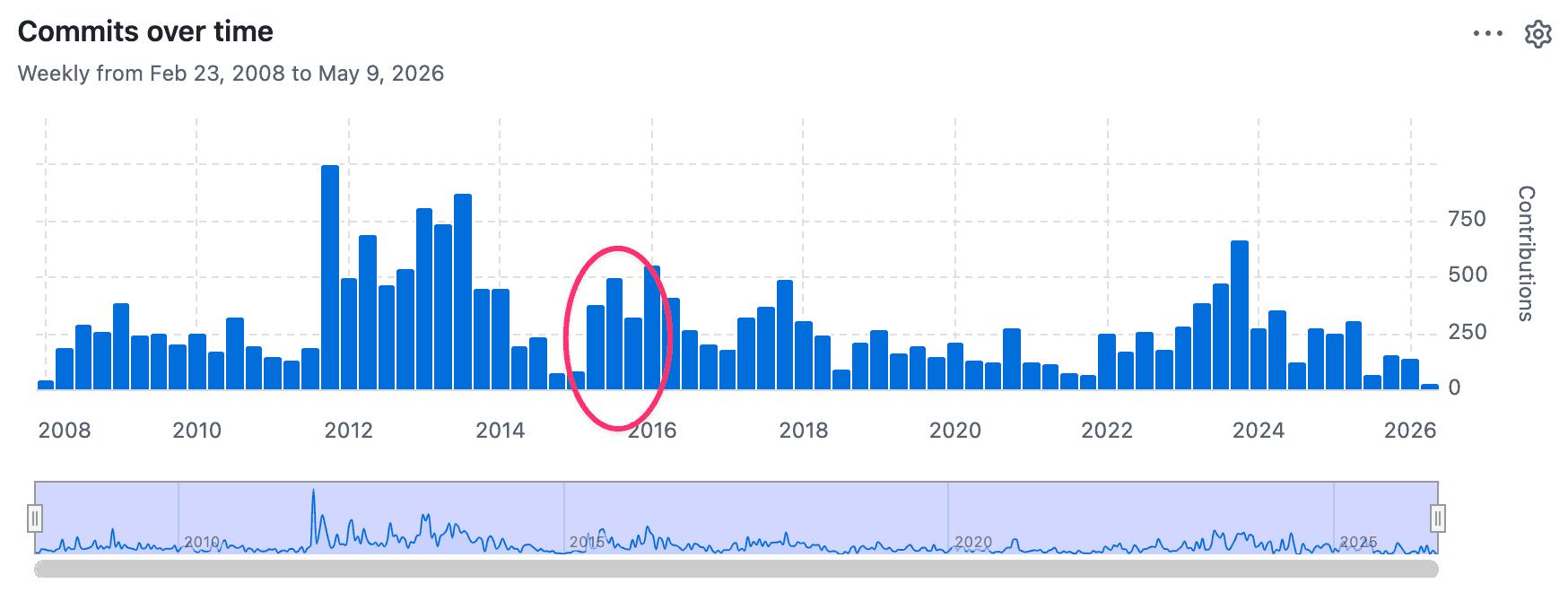
If we look at Solidus’s commit frequency, you instead see a continuous period of development, led by now Rails Core/Ruby Committer John Hawthorn, alongside a number of consultancies and digital commerce businesses.
Solidus wasn’t created because of the Spree Commerce acquisition, though. It was created by a group of agencies and store operators who were invested in the platform and were unhappy with how it was being maintained, specifically around upgrades.
While the tolerance for software development overhead was higher during the ZIRP era, online stores have always been very focused on their bottom line. Spree released a series of minor versions that were unnecessarily difficult to upgrade. The benefits of upgrading didn’t outweigh the costs. This led stores to stay on old versions, not only incurring the cost of backporting security fixes, but fragmenting the community and ecosystem.
Solidus fixed this. Every release of Solidus is designed to make upgrading as easy as possible. This ensures everyone gets timely security patches, has access to new features, and is incentivized to contribute back to the platform.
That’s all history now. Both Solidus and Spree have healthy communities and active maintainers. Spree saw some stagnation from late 2021 through early 2024, but has since seen a big uptick in activity, primarily driven by LLM-generated contributions. Solidus has a more consistent contribution history, driven primarily by users of platform contributing features driven by their real-world needs.
Since it’s 2026 and no article can be written about anything without mentioning AI, I figured I’d ask Claude about the difference between the platforms. I know prospective users of the platform are probably doing the same and I wanted to know what the LLMs had to say. Here’s Claude’s answer.
Much of the answer is technically correct. Let’s examine Claude’s short version:
Spree in 2026 is a more aggressive, product-led platform. Version 5.0 (April 2025) split the project into a free Community Edition under BSD-3-Clause and a commercial Enterprise Edition adding B2B, marketplace, and multi-tenant modules. The 5.4 stack ships a Next.js 16 storefront, React 19, Tailwind CSS 4, a TypeScript SDK, and an OpenAPI 3.0 REST API as a one-command install. Backed commercially by Vendo.
Solidus is the more conservative, community-governed fork. It’s directed primarily by Nebulab and funded through Open Collective backers and sponsors. The roadmap moves more slowly but with strong emphasis on backward compatibility, code quality, and not breaking existing stores.
What the Spree team claim as features are actually liabilities. I’ve seen many teams build storefronts with Next.js on top of Solidus, but they invariably found the same thing: the increased complexity wasn’t worth it. The JavaScript ecosystem is a mess. Digital commerce businesses want simple and efficient solutions, not multiple web stacks.
The licensing is another issue. While the core of Spree’s source remains under an open license, they’ve locked multi-tenancy and marketplace functionality behind a 5-figure annual license. Solidus remains completely free. No fees whatsoever. You own your eCommerce stack.
That brings us to governance. Spree is managed by a single company. Over the last two years, more than 90% of the commits to the project come from that company. Over 70% of the non-merge commits in that period are from one person.
Solidus, on the other hand, has followed a community-driven approach. The core team is made up of representatives from a variety of different companies who are all invested in the long-term health of the platform. Folks associated with Nebulab, Blish, CandleScience, ourselves and a variety of independent consultants all regularly make contributions to the project.
Choosing Solidus means choosing stability, thoughtfulness, and control. The core team keeps Solidus lean and focused on the needs of real digital commerce businesses. We’ve made it as easy as possible to upgrade, so that when we ship new features, you can try them out immediately. Finally, we’ve kept the licensing unencumbered so that you own your eCommerce stack.
Get in touch if you want to take control of your digital commerce experience.